The Invisible Referee: What the Commonwealth Games Taught Us About Sporting Algorithms

Mark Swan thought he had won bronze
After his final lift in the men's lightweight para powerlifting competition at the Glasgow 2026 Commonwealth Games, the English lifter stepped away from the platform believing two athletes had finished ahead of him.
Moments later, he learned he had become the first gold medallist of the Games.
There had been no judging error, successful appeal or disqualification. The result had always been correct. What changed was Swan's understanding of how the competition had been scored.
The publicly displayed scores showed Swan and Nigeria's Roland Ezuruike tied on 153.9 points. Additional decimal precision, which was not visible on the results screen, separated them and awarded Swan gold.
For many viewers, it was an unusual introduction to one of modern sport's fastest-growing challenges. Increasingly, mathematics does more than support sport. It helps govern it.
Algorithms now influence rankings, qualification pathways, handicaps, tie-breaks and, in some sports, the allocation of medals themselves. As these systems become more sophisticated, an important question emerges:
When algorithms determine sporting outcomes, how transparent should they be?
Sport has a new official
When we think about sporting officials, we usually picture referees, judges or umpires. Their role is visible: they apply rules, interpret events and explain important decisions.
Modern sport has quietly acquired another official.
Algorithms.
Unlike human officials, algorithms do not wear uniforms or carry whistles. They sit behind scoreboards, rankings and qualification systems, applying mathematical rules to determine outcomes that would otherwise be difficult — or impossible — to compare fairly.
Most spectators never notice them until something unexpected happens.
The Glasgow competition offered precisely that moment.
Glasgow was not a failure of mathematics
Para powerlifting at the Commonwealth Games differs from the format used at World Championships and the Paralympic Games. Instead of awarding medals across ten men's and ten women's bodyweight categories, the Games combine athletes into lightweight and heavyweight events.
That creates a genuine comparison problem. A heavier athlete will generally lift more absolute weight than a lighter athlete. Ranking athletes only by kilograms lifted would therefore systematically favour larger competitors.
A bodyweight-adjusted coefficient provides the solution. Each successful lift is converted into points intended to compare performances across different bodyweights.
The algorithm was not an unnecessary complication. Without it, combined-category competition would not be credible.
The issue exposed in Glasgow was different. The calculation appears to have been applied correctly, but the decisive information was not visible to the athlete or audience.
The mathematics succeeded. The communication did not.
Accuracy is only part of the story
Scientific evaluations of sporting formulas usually ask whether the model produces equitable outcomes across competitors.
That remains essential. Strength does not increase in direct proportion to body mass, and every coefficient is an approximation of a complex biological relationship. Research has shown that some powerlifting formulas advantage particular regions of the bodyweight spectrum, which is why governing bodies periodically revise them.
Our current research analysed 10,561 international para powerlifting performances and compared the Haleczko and para-DOTS systems with a newly developed coefficient. The proposed coefficient produced improved or comparable scoring neutrality in several competitive contexts, particularly among higher-performing athletes. However, no coefficient completely eliminated bodyweight-related variation.
That finding is not an indictment of mathematical scoring. It demonstrates how difficult it is to compare diverse human performances using one equation.
Glasgow suggests that sporting organisations should ask another question alongside statistical fairness:
Can athletes, coaches and spectators understand the result?
An algorithm may be accurate while still being opaque. To the scoring system, Swan and Ezuruike were not tied. To almost everyone watching, they appeared to be.
Algorithms already govern modern sport
Para powerlifting is not unique.
Cricket uses the Duckworth-Lewis-Stern method to reset targets following weather interruptions. World Athletics rankings influence entry into major championships. Cycling points affect qualification and selection. Sailing uses handicap systems to compare performances across different boats and conditions.
These models solve legitimate problems. They allow sports to account for interrupted matches, unequal competitive conditions or athletes who cannot be compared through raw performance alone.
Their growing importance also means they increasingly perform a governance role. They help decide who qualifies, progresses, wins and stands on the podium.
This role will expand as artificial intelligence, computer vision and automated judging become more common. The challenge is no longer whether sport should use algorithms. It already does.
The challenge is ensuring those systems earn the trust of the athletes they affect.
The Algorithm Transparency Principle
A trustworthy sporting algorithm should satisfy four criteria.
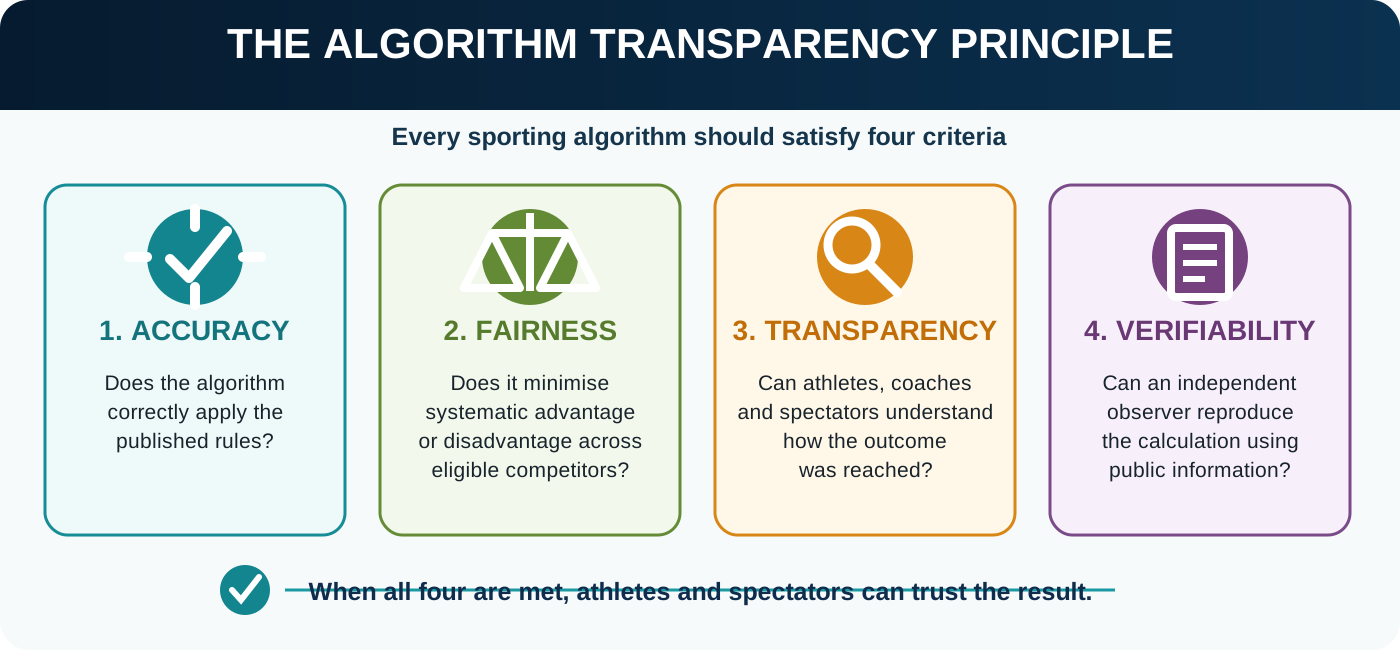
Accuracy
Does the algorithm correctly apply the published rules?
Fairness
Does it minimise systematic advantage or disadvantage across eligible competitors?
Transparency
Can athletes, coaches and spectators understand how the outcome was reached?
Verifiability
Can an independent observer reproduce the calculation using publicly available information?
These principles overlap, but they are not interchangeable.
An accurate result may still be poorly communicated. A transparent model may still contain systematic bias. A fair model cannot be independently trusted if the formula, coefficients or decisive level of precision remain unavailable.
Research into interpretable machine learning has made a similar point: explanations matter because people must decide whether to trust and act on a model's output. Most sporting coefficients are not artificial intelligence, but the underlying human problem is the same. When an automated calculation produces a consequential decision, people need a reasonable path to understanding it.
Transparency is part of sporting integrity
Improving transparency does not require abandoning sophisticated mathematics or replacing existing formulas.
Relatively small changes could substantially improve understanding:
- Display sufficient decimal precision when medal positions are close.
- Explain scoring and tie-break procedures before competition begins.
- Provide public calculators and worked examples.
- Give commentators accurate briefing material for live broadcasts.
- Publish the formula, coefficients and rounding rules in an accessible format.
- Provide a clear post-event explanation when an algorithm determines a close result.
None of these measures would alter the winning performance. They would make the pathway from performance to outcome visible.
Transparency should therefore be treated as more than a communications exercise. It is part of sporting integrity.
The future referee may be invisible
Technology has always transformed competition. Electronic timing replaced hand-held stopwatches. Video review changed officiating. Wearable sensors reshaped athlete preparation.
Algorithms are another stage in that evolution, but they differ in an important way. They do not simply measure performance. Increasingly, they determine what that performance means.
The lesson from Glasgow is not that sporting algorithms are broken. The result appears to have been produced according to the rules.
The lesson is that correct mathematics can still create confusion when the decisive information remains invisible.
As algorithms become another official in modern sport, perhaps we should expect from them what we expect from referees: not only that the decision is correct, but that athletes and spectators can understand why.
Because confidence in competition depends on more than reaching the right answer.
It depends on making the reasoning visible.
References
1. Glasgow 2026 Commonwealth Games. English powerlifter Swan wins first medal of Glasgow 2026, Nigeria's Nworgu also tops podium. Published 24 July 2026.
2. Sinclair RG. Normalizing the performances of athletes in Olympic weightlifting. Canadian Journal of Applied Sport Sciences. 1985;10(2):94-98.
3. Vanderburgh PM, Batterham AM. Validation of the Wilks powerlifting formula. Medicine & Science in Sports & Exercise. 1999;31(12):1869-1875. doi:10.1097/00005768-199912000-00027.
4. Cleather DJ. Adjusting powerlifting performances for differences in body mass. Journal of Strength and Conditioning Research. 2006;20(2):412-421. doi:10.1519/R-17545.1.
5. Ferland PM, Allard MO, Comtois AS. Efficiency of the Wilks and IPF formulas at comparing maximal strength regardless of bodyweight through analysis of the OpenPowerlifting database. International Journal of Exercise Science. 2020;13(4):567-582. doi:10.70252/XGHM8852.
6. van den Hoek DJ, Namgay P, Beaumont PL, Latella C. Developing and optimising a new coefficient to improve competition scoring and outcomes in World Para Powerlifting competitions. Manuscript under review.
7. Duckworth FC, Lewis AJ. A fair method for resetting the target in interrupted one-day cricket matches. Journal of the Operational Research Society. 1998;49(3):220-227.
8. Ribeiro MT, Singh S, Guestrin C. “Why Should I Trust You?”: Explaining the predictions of any classifier. In: Proceedings of the 22nd ACM SIGKDD International Conference on Knowledge Discovery and Data Mining. 2016:1135-1144.
9. Doshi-Velez F, Kim B. Towards a rigorous science of interpretable machine learning. 2017.